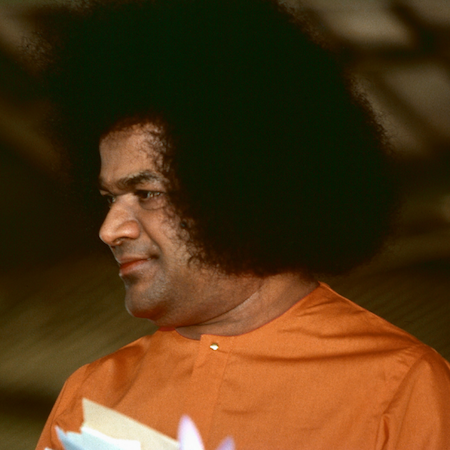
От какого сна мы должны пробудиться, согласно Упанишадам? Бхагаван объясняет и ведет нас сегодня по пути самопознания.
Не зная о Джняне (высшем знании), человек живет в неведении, в мире иллюзий. Погруженный в это состояние сна, он забывает о своей природе. Человек может быть президентом, императором или премьер-министром, но в состоянии сна он не осознает своего положения. Он считает сны, которые видит в этом состоянии, реальными и чувствует, что это его истинное состояние. В этом состоянии сна бедный человек может думать, что он император (или президент). Но в момент пробуждения он осознает свое реальное положение и статус. Точно так же человек в своем состоянии сна аджнаны (невежества), забывая свою истинную форму Сатчитананды, отождествляет себя со страной, родом занятий или физической формой. Именно это невежество окутывает человека иллюзией. Так же как нельзя увидеть рис, когда он покрыт шелухой, или увидеть воду под слоем мха, или солнце, скрытое облаками, человек, окутанный невежеством, не способен увидеть своё истинное Я. Поэтому Упанишады призывают человека пробудиться ото сна невежества и осознать свою истинную природу. Когда шелуха удалена, рис становится виден. Он был там, в рисовом поле, в рисовом зерне. Но из-за шелухи, покрывающей его, его было не видно. — Божественная беседа, 4 апреля 1992 г.
Исследование, которое начинается с Кохам (Кто я?), должно закончиться Сохам (Я Божественен). Только тогда человеческая жизнь обретает истинное значение и полноту.
— БАБА
Спойлер
Thought for the day
Thursday, January 29, 2026
What is the dream we must wake up from, as per the Upanishads? Bhagawan explains and leads us towards Self-knowledge today.
Oblivious to Jnana (higher knowledge), man lives in ignorance in a dream world of illusions. Immersed in this sleeping state, he forgets his nature. One may be a president, an emperor or a prime minister, but in the sleeping state, he is not conscious of his position. In the dreams he experiences in this state, he considers them to be real and feels that these are his true state. In that dream state, a poor man may think he is an emperor (or a President). But the moment he wakes up, he is conscious of his real position and status. Likewise, man in his dream state of ajnana (ignorance), forgetting his true form of Satchitananda, identifies himself with a country, a profession or a physical form. It is this ignorance that envelops man in delusion. Just as one cannot see the rice when it is covered by husk, or see the water underneath a layer of moss, or the sun covered by a cloud, a man enveloped in ignorance is unable to see his true self. Hence, it is that the Upanishads have exhorted man to wake up from his sleep of ignorance and realise his true nature. When the husk is removed, the rice is visible. It was there in the paddy. But because of the husk covering it, it could not be seen. — Divine Discourse, Apr 04, 1992
The enquiry which begins with Koham (Who am I) should end with Soham (I am Divine). Only then human life has real significance and fulfilment.